Robusta coffee (the species Coffea canephora, sometimes casually called “Coffea robusta”) is grown mostly in warm, humid, low-to-mid elevation parts of the Coffee Belt—think tropical regions in Southeast Asia, equatorial Africa, and parts of Brazil. If a label says “robusta,” it’s usually pointing to those climates (and to coffees built for body, crema, and caffeine).
Fast answer: Most robusta is grown in Southeast Asia (especially Vietnam), tropical Africa (notably Uganda and Côte d’Ivoire), and Brazil (often labeled as conilon).
Robusta isn’t grown “everywhere coffee grows”—it clusters in a handful of warm, humid regions. One World Coffee Research overview notes that six countries—Vietnam, Brazil, Indonesia, Uganda, India, and Côte d’Ivoire—produce the vast majority of the world’s robusta, with a second tier (like Laos and Thailand) trailing behind. That concentration makes robusta one of the easiest coffees to map: learn the regions once, and labels start making more sense fast.
Quick map to keep in your head
Southeast Asia supplies the biggest share (especially Vietnam). Africa is robusta’s home base and still a major producer (notably Uganda and Côte d’Ivoire). Brazil grows robusta too—often called conilon—mostly in warmer, lower areas than its famous arabicas.
Zooming out: this is also a shortcut to where coffee is grown in the world. Coffee grows across the Coffee Belt, but which species thrives depends heavily on elevation and temperature—robusta tends to take the warmer belts, while arabica tends to take cooler highlands.
Where robusta can grow (and where it can’t)
In a sentence: Robusta thrives in moist heat—tropical lowlands to warm mid-elevations—when water and temperature stay relatively steady.

Robusta isn’t “heat-proof,” but it is more tolerant of warmth and humidity than many arabicas. In practice, robusta does best in tropical lowlands to mid-elevations, where nights stay relatively warm and water stress is manageable. Many robusta areas sit roughly below 2,600–3,300 feet (800–1,000 m), though real-world farms can run lower or higher depending on latitude, shade, and rainfall patterns. A helpful shorthand is: robusta likes the warmer half of the Coffee Belt, plus consistent moisture. robusta altitude and temps
This also answers a broader question: where does coffee grow? Coffee grows in the Coffee Belt, but it’s split by conditions—robusta succeeds where it’s warmer and wetter; arabica generally needs cooler temperatures (often at higher elevation) to hold quality.
If you picture robusta thriving where it’s warm most of the year and water is dependable, you’ll guess “where it’s grown” correctly most of the time.
Robusta-friendly signals
- Warm nights — fewer cold snaps; steady tropical temperatures.
- Moisture rhythm — rainfall or irrigation that carries the tree through flowering and filling.
- Lower elevation — valleys, plains, or foothills rather than high mountains.
- Managed shade — canopy or intercropping to reduce midday stress.
Deal-breakers to watch for
- Extended drought — especially during flowering; yields can drop fast.
- Cold exposure — repeated chilly nights at higher elevations.
- Big temperature swings — stress can show up in uneven ripening.
- Waterlogging — humidity is good; standing water is not.
Put simply: where can coffee be grown? Anywhere inside the Coffee Belt if the local temperature and elevation line up with the species you’re planting. Robusta claims the warmer, wetter lanes; arabica claims cooler, higher lanes.
Printable comparison worksheet (fill it in)
Use this as a quick planning tool. It’s intentionally simple: you’re just looking for a pattern that matches robusta’s comfort zone. It also doubles as a quick way to compare arabica and robusta coffee growing needs.
Robusta-leaning site notes
| Elevation feels low-to-mid (____ ft) |
| Humidity stays high most months |
| Water plan: rain / irrigation / both |
| Shade plan: canopy / intercropping / none |
| Dry season length: ____ months |
Arabica-leaning site notes
| Elevation feels high (____ ft) |
| Nights are cool; big day/night swing |
| Humidity is moderate; air feels drier |
| Dry season is pronounced and long |
| Frost/cold snaps are a real risk |
Tip: If the left column fills easily and the right feels like a stretch, robusta is the more realistic fit.
Where robusta is grown today (regional map + top producers)
In a sentence: Global robusta production is concentrated in a small set of tropical origins, so “where it’s grown” is surprisingly easy to map.
Most of the world’s robusta comes from a tight cluster of origins. If you only memorize one list, make it the “big six” producers—then treat everything else as a smaller second tier. (In World Coffee Research’s overview, that “big six” is the shorthand for where the bulk of global robusta supply comes from.) where robusta grows today
| Major origin | Typical growing zones (broad) | Why robusta fits there | Common use on the market |
|---|---|---|---|
| Vietnam | Central Highlands; warm uplands | Warm temps + defined seasons; managed water and scale | Espresso blends, instant, ready-to-drink bases |
| Brazil (conilon) | Lower, warmer coastal/inland zones | Heat-tolerant plant + irrigation in expanding areas | Blends, soluble coffee, some “fine robusta” lots |
| Indonesia | Sumatra lowlands, parts of Java/Sulawesi | Humid tropics; robusta thrives below many arabica zones | Blends and single-origin robusta in some regions |
| Uganda | Lake-adjacent lowlands; central regions | Equatorial warmth; robusta is historically rooted there | Soluble and blends; increasing quality focus |
| India | Southern growing belts; lower elevations | Monsoon patterns + shade systems; robusta resilience | Blends and domestic consumption; some specialty lots |
| Côte d’Ivoire | Humid tropical zones | Low elevation + tropical rainfall patterns | Soluble and blends; bulk trade |
| Second tier | Laos, Thailand, Tanzania, Madagascar (varies) | Where warmth + moisture align and land is available | Often regional blends; occasional standout microlots |
How to use the table: If you’re choosing a coffee for espresso blends, iced coffee, or higher caffeine, start with Vietnam and Brazil. If you’re exploring origin character (or “fine robusta”), Indonesia and Uganda are common jumping-off points—then look for processing details that signal extra care.
Top coffee-producing countries (coffee overall) — quick context
This article is robusta-first, but people often ask broader questions like which country produces the most coffee or who is the world’s largest coffee producer. Overall, Brazil is widely recognized as the largest coffee producer, while Vietnam is a major producer and the standout in robusta. If you’re searching for the top coffee producing countries or the top 10 coffee producing countries, you’ll usually see a mix of arabica-leaning origins (like Colombia and Ethiopia) alongside robusta-leaning origins (like Vietnam and Indonesia).
For time-specific queries such as global coffee production 2024 or “top coffee producing countries 2024,” the exact ordering can shift by crop-year conditions. The reliable approach is: pull the latest annual dataset, then compare it to this page to understand where coffee is produced overall versus where robusta coffee is grown specifically.
Southeast Asia (high volume)
Think “warm uplands + consistent production.” Vietnam is the headline, with Indonesia and nearby origins adding variety in processing styles and local cultivars.
Africa (home base + major supply)
Robusta is native to parts of West/Central Africa, and modern production remains significant—especially in Uganda and Côte d’Ivoire.
Brazil & the Americas (conilon + expansion)
Brazil grows robusta mainly in warmer zones and increasingly treats it as a strategic crop for supply stability. Elsewhere in the Americas, robusta is more limited and localized.
If you can name Vietnam, Brazil, Indonesia, Uganda, India, and Côte d’Ivoire, you’ve basically mapped “where robusta is grown” at a global level.
Southeast Asia: the modern robusta engine
In a sentence: Southeast Asia dominates modern robusta supply because it matches robusta’s climate needs and supports large-scale, consistent production.
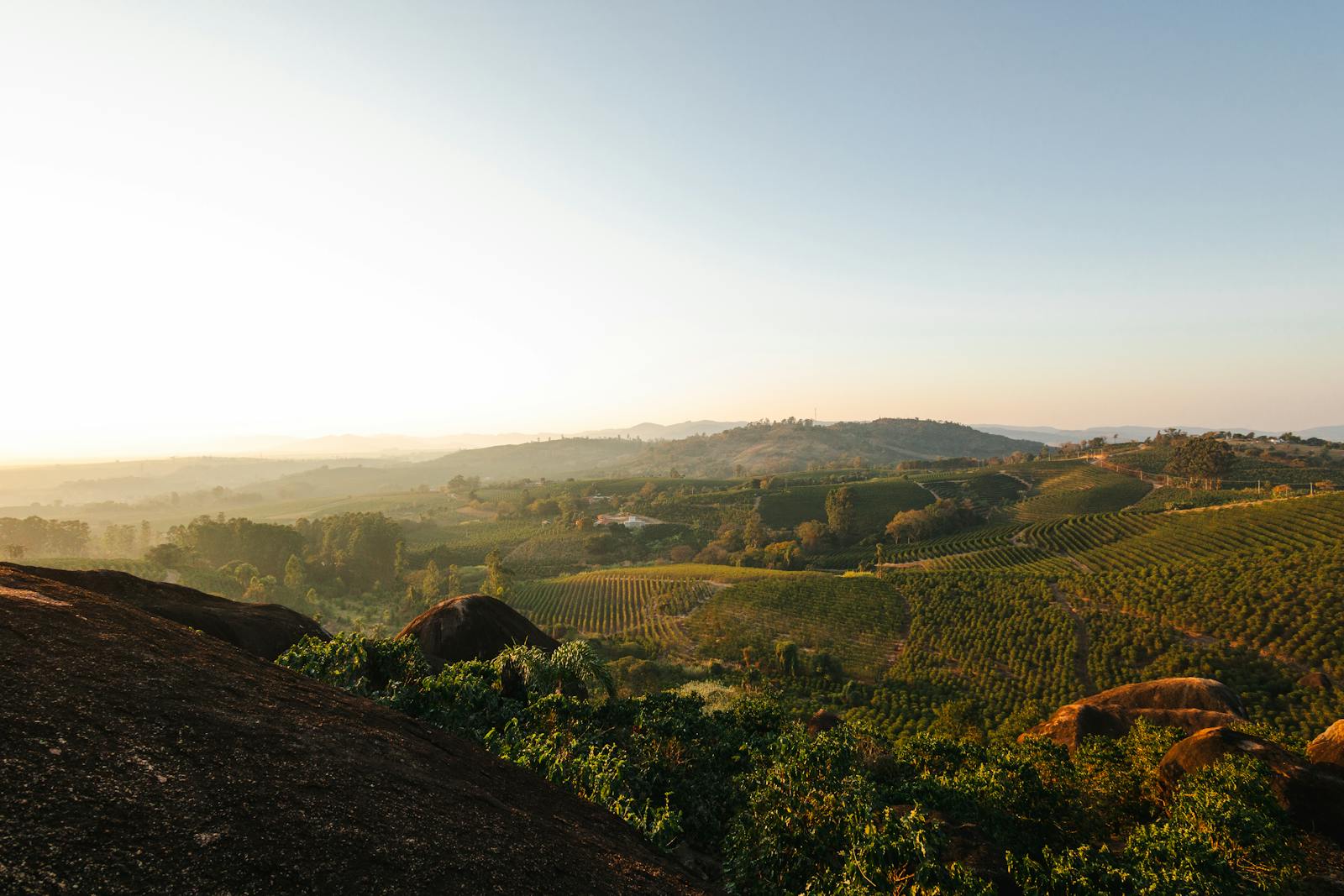
When people say “robusta,” they’re often really describing a supply story: big, consistent output from climates that support reliable yields. That story is especially visible in Southeast Asia. Many farms sit in warm zones where trees can produce steadily with the right management—fertility, water planning, and harvesting labor matter a lot at scale. On the trade side, robusta is also central to soluble coffee and as a backbone in blends, which reinforces why production tends to concentrate in places built for volume and logistics. Robusta market overview 2025
Picture a typical robusta coffee plantation here: long rows or clustered blocks of trees in warm uplands, often paired with planned fertilization and (in some areas) irrigation to keep flowering and cherry filling consistent across seasons.
Vietnam
Vietnam’s Central Highlands are the mental model most people should use for “modern robusta.” It’s warm, it can be very productive, and farms often operate with a practical, agronomic focus—varieties chosen for output, harvesting timed for efficiency, and water handled intentionally when seasons turn dry. That doesn’t mean every lot tastes the same; it means you’re more likely to find robusta presented as a component (body, crema, caffeine) rather than as a delicate, origin-forward single cup.
If you’re shopping and see “Vietnam robusta,” your safest expectation is: heavier texture, a firmer bitterness if roasted dark, and a pronounced “espresso blend” role. If the roaster calls it out as washed or natural robusta, or uses terms like “fine robusta,” that’s your hint they’re trying to show more sweetness and clarity than the default commodity profile. Example use: If your espresso tastes sharp, try a slightly lower dose or a shorter yield to keep the bitterness in check.
Quick terminology: when a bag says coffee robusta beans, it’s just the roasted seeds from the robusta plant. If you see green coffee beans robusta, that means the coffee is unroasted—typically how it moves through importing and roasting supply chains.
What “good robusta coffee” usually signals: clear origin info, a stated processing method, careful sorting (fewer defects), and a roast that aims for sweetness and structure instead of pure bitterness.
Indonesia and neighbors
Indonesia grows both arabica and robusta, but robusta commonly shows up at lower elevations and in warmer microclimates than many of the country’s famous arabica zones. What changes the experience is not just geography—it’s processing culture. You may see robustas that lean earthier or woodier when roasted dark, but you can also find lots that surprise you with cocoa-like sweetness when handled carefully and roasted with restraint.
One easy mental image is Sumatra—a big coffee-producing island where coffee agriculture can be both high-volume and highly regional, depending on altitude and local processing traditions.
Example use: For iced coffee, a medium-dark robusta-forward blend can taste fuller and less “watery” over ice—especially if you brew slightly stronger than usual.
Robusta isn’t “one taste.” In Southeast Asia, the biggest difference is often how it’s processed and roasted, not just where it’s grown.
- Blend role — crema, body, and caffeine lift.
- Roast behavior — darker roasts amplify bittersweet notes.
- Processing cue — washed can read cleaner; natural can read sweeter.
- Origin cue — Vietnam is the most common label signal.
- Quality cue — “fine robusta” suggests careful sorting and fermentation control.
- Use cue — instant/RTD often points to robusta-heavy supply chains.
In Southeast Asia, robusta clusters where farms can run warm-climate production at scale—and that’s why labels keep circling back to the same few origins.
Africa: robusta’s roots and major producers now
In a sentence: Africa is both robusta’s native home and a major modern supplier, especially in equatorial, humid growing belts.
Robusta is native to parts of West and Central Africa, and that matters because it helps explain robusta’s comfort zone: warm, humid, often lower-elevation forests and forest edges. Historically, that ecology gave robusta a different set of strengths than high-elevation arabicas—especially tolerance for heat and certain pests. Today, African robusta production spans multiple countries, but it’s best understood as a mix of legacy growing regions and modern supply hubs.
Native range, in one picture
Imagine a belt running through equatorial Africa where forests, rainfall, and warm temperatures overlap. That’s the “natural home” robusta evolved in. When robusta shows up in other parts of the world, it’s usually because growers found similar conditions—warmth plus water—often at elevations that would be too hot for arabica to hold quality consistently.
Uganda and Côte d’Ivoire (why they matter)
Uganda is frequently cited as a standout African producer because robusta is deeply established there and supports both export and local consumption. Côte d’Ivoire is also a major robusta origin in trade terms, often associated with bulk supply for soluble and blends. If you’re tasting African robusta as a single origin, you may notice the profile can tilt less “rubbery” and more cocoa/woody—especially when producers emphasize sorting and controlled fermentation.
Traceability note (useful when you buy)
Because robusta is often traded for blends and soluble coffee, labels can be vague. If you care about flavor transparency, look for country + region, a named producer/co-op, and a clear processing method. If you care about sustainability, look for credible traceability signals (not just buzzwords) and be cautious about “mystery blend” claims that don’t say where the coffee came from.
In Africa, robusta is both “where it started” and “where it still thrives,” especially in humid, equatorial climates.
Brazil and the Americas: conilon, new plantings, and what’s changing
In a sentence: In the Americas, robusta is most prominent in Brazil (conilon), grown in warmer belts and increasingly expanded for supply stability.
Brazil is famous for arabica, but it also grows robusta—often called conilon—and that matters if you’re trying to decode labels. In Brazil, robusta tends to be planted in warmer, lower areas than many classic arabica regions. The big shift in recent years is that robusta isn’t treated as an afterthought: it’s increasingly framed as strategic supply, supported by agronomy and, in some areas, irrigation and expansion planning.
Brazil’s conilon regions (plain-language geography)
When you see “Brazil conilon,” think of robusta from Brazil’s warmer belts—areas that can support productive coffee where arabica might struggle with heat stress. The practical takeaway for readers is simple: “Brazil robusta” on a bag doesn’t mean the coffee is from the same highland landscapes you associate with sweet, nutty Brazilian arabicas. It’s usually from a different set of conditions and is more likely to be used to build body and chocolatey bitterness in a blend.
News coverage has also highlighted Brazil’s potential to expand robusta output as producers look for resilience and scale in a volatile coffee market. Brazil robusta expansion outlook
Central America and trials (why it’s limited)
Outside Brazil, robusta exists across the Americas, but it’s typically more localized than the major Southeast Asia and Africa hubs. The limiting factor is often the same one that defines robusta globally: you need the right combo of warmth, moisture, and manageable disease pressure. In some places, robusta is explored as a way to keep coffee viable in hotter zones—while higher elevations remain better suited for high-quality arabica.
That leads to another common question: is coffee grown in the United States? Yes—commercially, it’s relatively small compared with tropical producers, and people often ask what US state grows the most coffee beans. The short answer is that U.S. coffee production is concentrated in tropical or near-tropical zones, with Hawaii as the best-known producer.
Where are arabica coffee beans grown?
Broadly, arabica is grown across cooler, higher-elevation Coffee Belt regions—especially in Latin American highlands and parts of East Africa—because those conditions help it develop sweeter, more aromatic profiles. This is why a bag labeled “arabica” often signals a different growing environment than robusta, even before you taste it.
Terminology that helps you read labels
Coffea canephora is the species. “Robusta” is the common market name for many of its types. “Conilon” is a name often used in Brazil for robusta/canephora coffees. If you see any of these terms, you’re usually looking at the same broad category of coffee—grown in warmer, lower-elevation zones than many arabicas.
| Label clue | What it often signals | How to use the info |
|---|---|---|
| “Conilon” | Brazilian robusta/canephora | Expect blend utility; look for processing notes if sold as single origin |
| “Fine robusta” | Quality-focused robusta marketing | Look for region + processing + harvest/lot detail to back it up |
| “Espresso blend” | Often includes robusta for crema/body | If bitterness is too strong, try a lighter roast or lower ratio |
| “Instant/soluble” | Robusta-heavy supply chains are common | Origin disclosure may be limited; prioritize trusted brands/traceability |
In the Americas, robusta is most visible through Brazil’s conilon—grown in warmer zones and increasingly treated as a strategic crop.