Best Espresso Scale is less about “most features” and more about fit + speed + repeatability. If your scale can’t live under your cup, it won’t live in your workflow.

Most “coffee scales” can weigh a shot. The best espresso scale does three things better: it reacts quickly, stays stable through vibration, and fits under your cup without making you do espresso Jenga.
If you’re shopping for the best coffee scale or the best coffee scale for espresso, think of it as picking a daily-use barista scale—fast enough to stop shots on target, simple enough to trust when you’re half-awake.
Here’s the pattern you’ll see across leading buying guides: the “best” espresso scale isn’t the priciest—it’s the one that’s compact, stable, and updates fast enough to help you stop shots on target. When those basics are right, the rest (apps, modes, extra metrics) becomes optional.
TL;DR — Quick way to pick
- Small drip tray: choose an espresso-first footprint and verify clearance.
- Daily home bar: prioritize stability + wipe-friendly surfaces over extra modes.
- Budget buy: pick a reliable 0.1 g scale, then protect it from steam and spills.
- What matters most: speed + fit, then readability, then durability.
- Spec sweet spot: 0.1 g steps, easy tare, timer you can control.
- Next step: run the 60-second fit test below before you shop.
At-a-glance picks (and who each is for)
If you want one shortcut, make it this: choose by footprint first, features second. A “perfect” scale that doesn’t fit ends up in a drawer, and your shots end up back on vibes.
For a broader list of options people use as a pour over coffee scale and espresso scale combo (especially if you want the best scale for pour over coffee too), see tested coffee scales 2025. Use it as a starting point—then filter by your machine’s clearance and tray stability.
Best overall for most home espresso bars
Pick a compact, wipe-friendly espresso digital scale with a clear timer and stable readings on a vibrating drip tray. If you pull multiple drinks a day, prioritize predictable tare and a platform that doesn’t rock when you set your cup down.
Best budget option that still feels responsive
Choose a simple 0.1 g digital coffee scale with a timer that works well in manual mode. This is where most people find the best budget coffee scale or best inexpensive coffee scale—great performance, fewer durability perks, and a bigger payoff if you keep it dry.
Best ultra-compact choice for tight drip trays
If your cup barely fits under the group head, prioritize a small footprint and low profile even if the platform is tiny. This is the “mini coffee scale” lane, and it’s often the best answer for an espresso machine drip tray.
| Pick type | Best for | What to look for | Common tradeoff |
|---|---|---|---|
| Espresso-first compact | Tight drip trays, bottomless portafilters | Low profile, fast refresh, stable reading | Smaller platform; fewer buttons |
| Home bar all-rounder | Espresso + pour-over in one scale | Readable display, good tare, durable top | May be too big for some trays |
| Budget-friendly | First setup, occasional espresso | 0.1 g steps, consistent behavior, simple timer | Less water/steam protection |
| Ultra-minimal travel | Office bar, compact machines, travel kit | Pocket size, quick tare, decent battery | Tiny display and platform |
The “best” espresso scale is the one you can leave on the tray every day—without thinking about it.
Practical espresso rule
Measure your machine first (the 60-second fit test)
Before you compare features, lock in the one constraint you can’t upgrade later: your drip-tray clearance and usable platform area. This is what separates “works in theory” from “works mid-shot.”
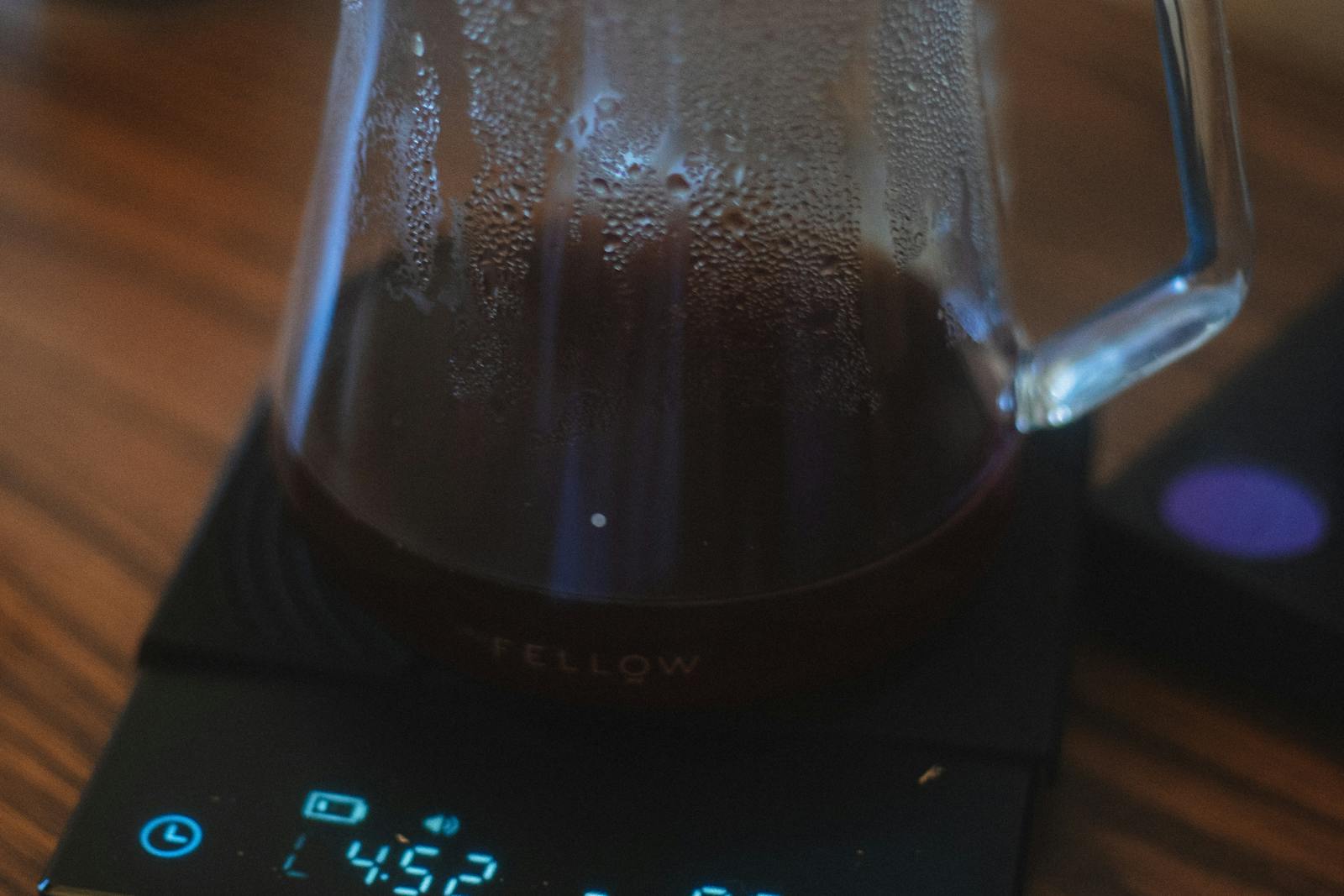
Step 1: Measure clearance. With the drip tray installed, measure from tray surface to the spouts (or bottomless portafilter clearance). You need room for: scale + cup + a little “wiggle.”
Step 2: Measure platform space. Measure the flat area where a scale can sit without rocking. If the tray has ridges, note the true stable zone (often smaller than it looks).
- Clearance rule: if it’s tight, favor a low-profile scale and a lower cup.
- Platform rule: if the tray is narrow, favor a smaller footprint over a larger platform.
- Stability rule: if the tray vibrates, prioritize a steady reading over fancy modes.
Quick sanity check: Put your usual cup on a cutting board (as a “fake scale”), slide it under the group head, and practice removing the cup with one hand. If you bump things now, you’ll bump things with a real espresso machine scale there too.
If you brew with a bottomless setup, treat this as choosing a portafilter scale: it needs to sit flat, stay readable, and leave room for fast cup movement.
Safety note: If your machine purges hot water or drips after brewing, you’ll want a scale with a sealed top (or a protective mat) and a habit of wiping the tray between shots.
The must-have features for espresso
Once you know what physically fits, judge everything else by a simple standard: does it help you make faster, cleaner decisions mid-shot? Espresso happens quickly; a scale that lags can push you into late reactions.
Fast response and stable readings
Espresso is noisy: pumps vibrate, trays flex, and drops keep falling. The best coffee scale for espresso refreshes quickly and doesn’t “bounce” between numbers. This matters more than chasing ultra-fine resolution, and it’s why many guides emphasize responsiveness and stability; see the overview in reaction time scale guide.
A practical way to judge “fast enough” at home: if you routinely overshoot your target yield by 2–4 g because the display feels behind, you’ll benefit more from a quicker, steadier coffee weighing scale than from extra features.
Practical resolution and capacity
Resolution: 0.1 g steps are the everyday sweet spot for espresso. If your recipe is 18 g in → 36 g out, a 0.1 g scale lets you stop at 36.0 g instead of guessing “close enough.” That’s already plenty of control for dialing in taste.
When 0.01 g matters: it’s most useful for experiments where tiny changes are the whole point (very small doses, ultra-light roasts, or detailed flow profiling). If the reading jitters or lags on your tray, extra decimals won’t help—stability will.
Capacity: You don’t need a huge max weight for espresso, but you do want enough headroom that the scale behaves consistently with your cup, dosing cup, or small pitcher. A scale operating near its limit can feel less stable or more sluggish.
Heat, water, and real-life durability
Steam wand splatter, condensation, and quick wipe-downs are part of espresso life. A sealed top, tactile buttons, and a display that doesn’t fog up are boring features—until you’re pulling back-to-back shots and don’t want to baby your gear.
Also watch for “helpful” behaviors that become annoying: aggressive auto-off, touch buttons that misfire when damp, or auto-tare rules you can’t override. The best scale still works great in plain manual mode—especially if you use it as a drip coffee scale or pour-over scale too.
Printable “espresso scale checklist” worksheet
Use this once, and you’ll know exactly what you need. Fill it in on your phone (or print it) before you buy. If you’re comparing products online, copy the product dimensions and check them against your tray measurements.
| Field | Your notes (tap to edit) |
|---|---|
| Drip-tray clearance (scale + cup) | |
| Stable platform area (width × depth) | |
| Cup footprint (your usual cup) | |
| Non-negotiables (timer, sealed top, auto-off control) | |
| Nice-to-haves (flow-rate mode, auto-tare, app) | |
| Dealbreakers (too tall, unreadable display, button lag) |
Quick scoring idea: any candidate that fails “fit” or “stability” is out—no matter how many modes it has.
Timer, auto-tare, and “smart” modes: what’s useful (and what isn’t)
“Smart” features can be great, but only if they’re predictable. The real goal is less thinking during extraction—not more menus.
For most home setups, the best coffee scale with timer is simply a coffee scale with timer that’s easy to run manually. If you prefer espresso-first wording, it’s the same idea: an espresso scale with timer that doesn’t make you fight the interface.
Timer you can trust
A built-in timer is useful when it’s easy to start and stop without fiddling. The best versions have big, readable digits and don’t reset accidentally when you tare. In practice, that’s what people mean when they say “coffee timer scale.”
- Start method: one button, no long-press surprises.
- Readability: glanceable at a low angle on a tray.
- Consistency: keeps counting even when flow slows near the end.
Auto-tare and auto-start
Auto features can streamline a workflow, but they’re also the first place cheap firmware gets weird. If a mode ever “gets in your way,” turn it off and go manual—because espresso is too fast for second-guessing your tools.
- Best case: it starts timing when the first drops hit.
- Worst case: it triggers early from vibration or preinfusion drips.
- Rule: you should be able to disable it and still love the scale.
Smart apps and Bluetooth features
If you like tracking recipes, a smart coffee scale can be fun—especially when it doubles as a Bluetooth coffee scale for logs, ratios, or simple brew tracking. If you don’t enjoy data, skip the app and spend the money on durability instead.
How to dial in espresso with a scale (quick workflow)
The most useful espresso metric is simple: dose in grams → yield in grams → time in seconds. When you can repeat those three, you can taste changes clearly instead of chasing randomness.
One underrated combo is using a basic kitchen scale for coffee as your coffee bean scale for weighing dose, then using a compact espresso scale on the drip tray for the shot. A kitchen scale is often too large to work as an espresso tray scale, but it’s perfect for beans.
Step 1: Set your dose
Weigh your beans (or your ground dose) consistently. This removes a huge source of variation before you even pull a shot.
- Target: keep dose within ±0.2 g while dialing in.
- Habit: tare the dosing cup or portafilter every time.
Step 2: Pull to a target yield
Place the cup on the scale, tare, start the timer, and aim for a repeatable yield (for example, a 1:2 ratio as a baseline).
- Baseline: 18 g in → 36 g out (adjust by taste).
- Stop cue: stop slightly early if your machine drips heavily after pump stop.
Micro-case: If your shots taste thin and you’re hitting 36 g in 22 seconds, try grinding a bit finer and keep the yield the same. If it tastes harsh and you’re hitting 36 g in 35 seconds, try slightly coarser. The scale makes those tweaks “clean” because you’re not changing dose and yield at the same time.
Advanced note: stopping the shot without panic
Most home baristas overshoot because they react late. Try this: decide your stop weight, then plan to stop 0.5–1.0 g early if your machine drips after pump stop. The “right” offset is whatever makes your final settled yield repeatable.
If you’re wondering how to measure without scales grams, the honest answer is you can’t do it reliably for espresso. Even a budget scale will improve consistency immediately because it replaces guesswork with repeatable numbers.
Choosing by scenario: which kind of espresso scale fits your life?
People don’t buy espresso scales in a vacuum—they buy them for a routine. The goal is matching the scale to your most common shot, not the one-off weekend experiment.
If you’re looking for the best coffee scale for brewing that also works for espresso, aim for a stable all-rounder. If you’re hunting a best travel coffee scale, prioritize compact size, quick tare, and a readable display that doesn’t require perfect lighting.
| Your setup | Prioritize | De-prioritize | Why |
|---|---|---|---|
| Compact machine / tight tray | Low profile, small footprint, readable at angle | Huge platform, bulky buttons | Fit is the #1 failure point on many machines. |
| Milk drinks, back-to-back shots | Water resistance, stable readings, quick tare | Overly complex modes | Steam + splatter punish delicate scales fast. |
| Dial-in focused | Fast refresh, clear timer, optional flow rate | Auto modes that can’t be disabled | Predictability beats cleverness mid-shot. |
| Espresso + pour-over | All-round footprint, decent capacity, easy readability | Ultra-tiny platform | A slightly larger platform helps with brewers and servers. |
The budget sweet spot
In many guides, the “good enough” zone is a simple 0.1 g scale with a manual timer and predictable tare. Your goal at this price is consistency—not clever modes. If you treat it gently around steam, it can do excellent work.
When premium is worth it
Premium becomes easier to justify when you pull multiple drinks daily, share the station with others, or you’re tired of quirks: drift, foggy displays, or finicky buttons. That’s also where a tighter “espresso-first” shortlist can help; Coffee Chronicler’s roundup is one example of that approach in espresso scale picks 2025.
One trend worth noting: more compact “espresso cube” style scales are showing up to solve tiny-tray setups. If you’re curious about that form factor, a recent example is covered in cube scale 2025 review—use it as a shape reference, then still run the fit test.
Popular espresso scale models people compare
- Timemore: Timemore Black Mirror Mini, Timemore Black Mirror Plus, Timemore Black Mirror Pro, Timemore espresso scale, Timemore basic vs mini, Timemore Black Mirror Basic 2 review, Timemore Black Mirror Basic Pro review
- Acaia: Acaia Lunar espresso scale, Acaia Pearl scale, Acaia Pearl S scale, Acaia Lunar vs Pearl, Acaia Pyxis alternative
- Varia/Felicita: Varia Aku Mini, Varia Aku Pro, Felicita Arc
- Other common picks: Eureka Precisa scale, Weightman espresso scale, Greater Goods digital coffee scale, OXO Brew precision coffee scale, OXO Brew precision scale with timer, Breville espresso scale, Miicoffee scale
- Compact/travel: Normcore scale, Wacaco scale, Ikape scale, Zero Hero coffee scale
Use this list as a shortcut when you’re browsing comparisons—then apply the same rules from this guide: fit, speed, stability, and a timer you enjoy using.
If you’re searching specifically for the best espresso scale 2025, the same logic still wins: a fast, low-profile scale you can leave on the tray beats a feature-heavy scale you only use sometimes.
Care, calibration, and making your scale last
Espresso stations are hard on electronics. If you want reliability, treat your scale like a tool—not a coaster. The simplest rule is keep it dry, keep it clean, keep it consistent.
If you want the best waterproof espresso scale experience, look for sealed seams and wipe-friendly materials—not just a marketing claim. In real kitchens, moisture gets everywhere, so durability matters as much as specs.
Daily habits
- Wipe-down: dry the platform after each session (especially near buttons and seams).
- Battery: avoid leaving it plugged in where the cord can get wet.
- Storage: if your tray stays damp, store the scale off-tray between sessions.
Common failure points
- Steam: drifting readings after repeated hot moisture exposure.
- Sticky syrup: buttons that become inconsistent over time.
- Tray vibration: misreads that look like “inaccuracy” but are actually movement.
When should you calibrate?
If your readings drift at rest, or your dose/yield numbers stop matching reality across multiple coffees, calibration can help. If the scale behaves differently only on the drip tray, focus on stability and placement first—many issues are vibration, not calibration.
How to clean without killing it
Use a barely damp cloth, then a dry one. Avoid spraying cleaner directly on the scale. Keep water away from seams, ports, and button edges—especially right after steaming.
Safety note: Don’t place a scale where it can get blasted by steam wand spray or hot water purges. Heat + moisture is what kills most “works fine for pour-over” scales in espresso land.
Common shopping mistakes (and how to avoid them)
Most regrets come from predictable mismatches. Use this as a final check so your purchase is a “set it and forget it” win. The key is buying for your tray, not the spec sheet.
When you skim coffee scale reviews (or an espresso scale review), it’s normal to cross-check a Wirecutter coffee scale pick, search coffee scale reddit threads like best coffee scale reddit and best espresso scale reddit, and even see questions like “what digital scale is the most accurate reddit.” Those perspectives can be useful—but fit and responsiveness still decide whether you’ll enjoy using it daily. You may also hear “James Hoffmann coffee scale” mentioned in discussions; treat it as a cue to focus on workflow, not hype.
| Mistake | What it looks like | Fix |
|---|---|---|
| Buying too big | Scale hangs off the tray or rocks | Measure platform area and choose compact footprint |
| Chasing “more precise” | Finer steps but jittery numbers | Prioritize stability + refresh speed over extra decimals |
| Ignoring water exposure | Buttons glitch after a few weeks | Pick a sealed top or use a protective mat + wipe routine |
| Trusting auto-modes blindly | Timer triggers early or late | Choose a scale that’s excellent in manual mode |
Shopping note: The price of a scale can range from “first setup friendly” to premium gear. If you’re searching coffee scale Amazon listings or typing coffee scale near me, also check local kitchen stores and specialty coffee shops—returns and warranty can matter as much as specs. If you’re asking “where can i buy a digital scale,” the best answer is wherever you can verify dimensions, confirm the timer behavior, and easily return it if it doesn’t fit.
Final checkpoint: confirm (1) it fits with your usual cup, (2) it sits flat without rocking, (3) it tares instantly and predictably, and (4) you can read it at a low angle. If those four are true, you’ll get more benefit from dialing in than from any extra feature list.
If you want a final “sanity scan” before you buy, compare your worksheet against a few reputable roundups, then decide. Your perfect scale is the one that disappears into your routine and makes good shots repeatable.