Coffee Scale vs Kitchen Scale
If you’re measuring coffee, you’re usually measuring change: grams ticking up while you pour, seconds ticking by while you extract. A coffee scale is basically a scale + timer optimized for live pours and live shots. (And yes, this overlaps with “coffee scale vs food scale”—most “food scales” are standard kitchen scales.)
Rule of thumb: If you ever think “I need to hit exactly 30g… now,” a coffee scale starts paying for itself fast.
Units tip: use grams for repeatability; ounces are fine for casual cooking.
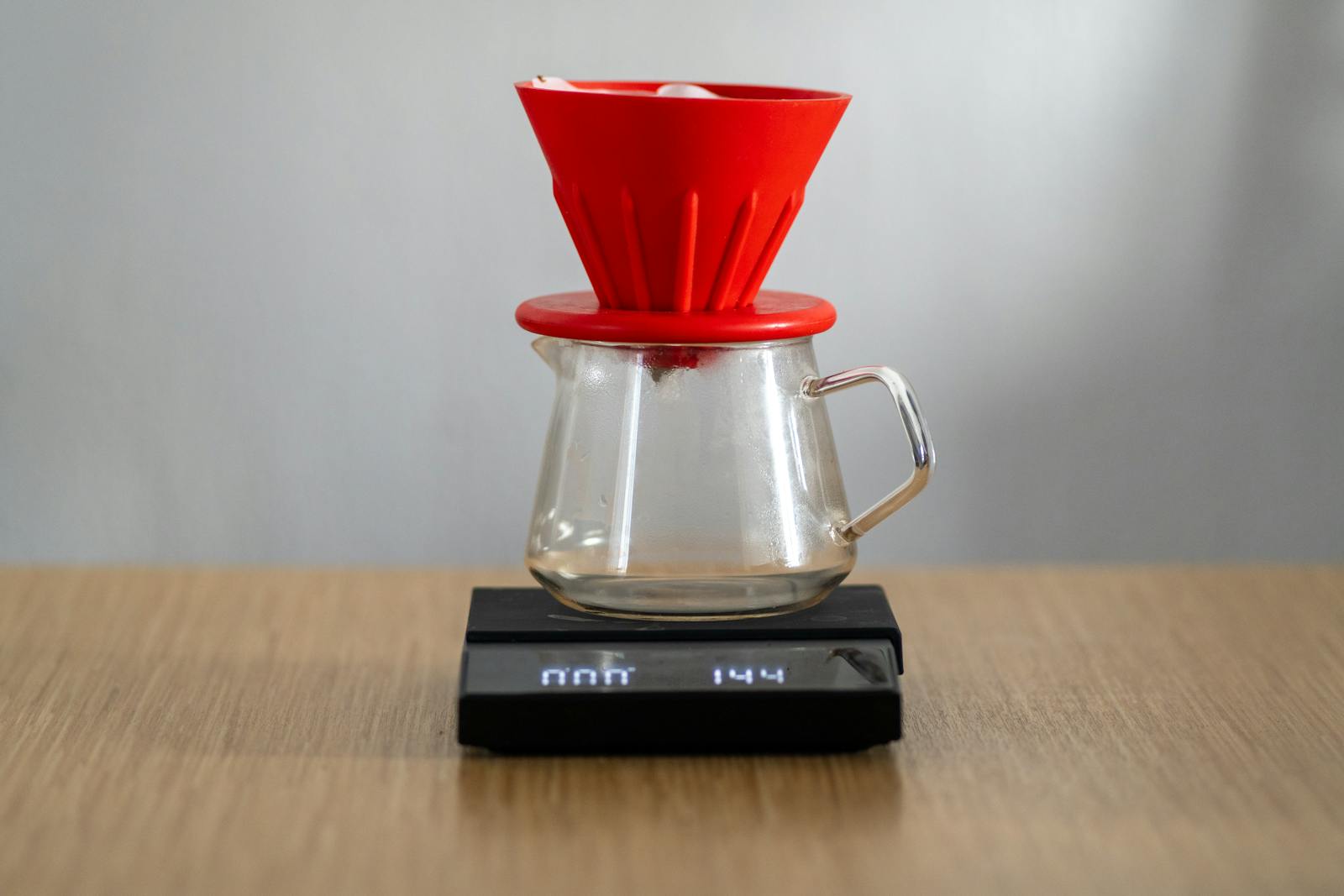
Most kitchen scales measure in 1-gram steps, while coffee-focused scales commonly read to 0.1 grams and pair that with an integrated timer—exactly the combo that makes espresso and pour-over repeatable. Once you stop measuring by scoops and start measuring by weight and time, your “good cup” becomes your default.
Coffee scale vs kitchen scale: the quick verdict
Here’s the honest take: a kitchen scale can absolutely make tasty coffee. The reason coffee folks upgrade isn’t because they hate kitchen tools—it’s because coffee is a fast feedback loop. You’re measuring small changes (dose, pour rate, yield) that happen in seconds, not minutes.
If you brew espresso or you care about consistent pour-over timing, get a coffee scale. If you mainly bake and occasionally weigh beans, a kitchen scale is fine.
You might also see the term kaffevekt—it simply means “coffee scale,” just labeled in another language.
- Buy a coffee scale if you do espresso, pour-over, or you’re actively “dialing in.”
- Use a kitchen scale if you mostly cook/bake and only weigh coffee beans before grinding.
- Choose a dual-use scale if you want one device and your coffee is mostly drip/pour-over (not espresso-obsessed).
Best for coffee
- Espresso: dose + yield changes are tiny, and time matters.
- Pour-over: you want live grams while you pour and a timer for the bloom.
- Recipe learning: you’re dialing in grind and ratio, not guessing.
Best for the kitchen
- Batch cooking: big bowls, big weights, simple reads.
- Baking: capacity and platform size beat ultra-fine increments.
- General use: you want one sturdy tool for everything.
The differences that actually change your cup
If you ignore every spec sheet on the planet and focus on just three things, you’ll make a good decision: resolution, response, and workflow. Those are the points where coffee scales and kitchen scales usually split.
A “better” scale isn’t about perfection—it’s about catching small changes fast enough to act on them.
Precision & resolution (0.1g vs 1g)
Many mainstream kitchen scales “step” by whole grams. That’s totally normal for flour and pasta—but it can be limiting when you’re weighing coffee, where a small dose swing can noticeably change extraction. That’s why coffee-focused reviews often call out 1-gram increments as the key limitation for brewing.
Quick example: if you brew 20g coffee to 320g water (*1:16*) and you accidentally dose 21g (easy to miss on a coarse scale), you’ve shifted closer to about *1:15.2*. That can taste heavier and a bit more bitter at the same grind—meaning you might “fix” the wrong thing when you troubleshoot. (If you’re searching “scale black coffee,” this is usually what you’re trying to control: repeatable ratio.)
Also: “accuracy” and “precision” are not the same thing. Accuracy is how close you are to the true value; precision is how consistently you can repeat the same reading. For most home coffee, repeatability is the real win—and general kitchen guidance does a solid job explaining accuracy versus precision in plain terms.
Response time & stability (lag, drift, refresh)
This is the sneaky one. A scale can be “precise” on paper but still feel frustrating if it updates slowly while you pour. With pour-over, you’re adjusting in real time—slowing down near your target, pausing at bloom, and hitting a final weight without overshooting.
20-second lag test: put a mug on the scale, tare, then pour a thin stream of water. If the numbers jump in delayed chunks (instead of tracking smoothly), you’ll likely overshoot targets during real brewing.
Quick safety note: if you brew directly under a kettle, assume splashes happen. Put a thin silicone mat on top (if your scale allows it), wipe spills immediately, and avoid soaking buttons—water + load cells is a bad combo.
Timer + ratio workflow (why it’s not “extra”)
A built-in timer sounds like a convenience feature—until you use it. Timing blooms, timing shot pulls, and timing staged pours remove a whole layer of friction. Some coffee scales even bundle timing with guided ratios and modes; that’s why gear testing often highlights coffee scale modes as the difference between “weighing” and “brewing with feedback.”
If you can’t measure it quickly, you can’t learn from it. A coffee scale is basically a tiny training tool for your routine.
When a kitchen scale is totally fine for coffee
If your coffee method is forgiving—or your doses are larger—your kitchen scale may already be “good enough.” If you’re specifically shopping for a kitchen scale for coffee, it works best when you’re brewing larger batches or weighing beans before grinding. Plenty of reviewers point out that, for most people, a regular scale plus a separate timer works well—WIRED even frames it as kitchen scale is enough unless you’re chasing a tighter workflow.
If you’re mostly brewing big batches (or measuring beans before you grind), you can get consistent results with a basic scale and a phone timer.
- Weigh the dose first: measure beans into the same cup each time, then grind.
- Use a consistent recipe: keep one ratio (like 1:16) and adjust grind before you change everything.
- Time with intention: start your phone timer at first pour (or when the pump engages) and stick to it.

Batch brew/drip and French press use cases
Drip makers and French press usually involve bigger doses and bigger water volumes, which naturally smooths out tiny errors. If you’re brewing 60g of coffee and you land at 61g, you can still make a delicious pot—especially if you keep your grind and water temperature consistent.
Simple workarounds that actually work
- Keep the same vessel: tare the same carafe or mug so your baseline stays consistent.
- Pour in stages: pause briefly so a slower display can “catch up” before your final target.
- Write one baseline recipe: once it tastes right, treat it like your reference point.
When a coffee scale is worth it (and what to look for)
A coffee scale is worth it when your method rewards small, fast adjustments. That’s most obvious with espresso, but it’s also true for pour-over if you’re trying to repeat a recipe and actually understand why one cup tastes better than the next.
Buy for the workflow you’ll do every morning: quick reads, easy tare, timer you’ll actually use, and enough durability for wet counters.
Must-have
- 0.1g resolution for coffee-dose range you actually use.
- Fast updates while pouring (no “late” jumps).
- Tare + timer that’s easy to hit with wet hands.
Nice-to-have (skip if budget matters)
- Splash resistance and a simple, wipeable surface.
- Long auto-off (or disable) so it won’t quit mid-brew.
- Rechargeable power if you hate battery swaps.
Espresso use cases (dose-to-yield, 25–30 seconds)
Espresso is where “small numbers” matter most. If your target is 18g in and 36g out, being off by a gram is a bigger deal than it sounds. A responsive scale helps you stop the shot at the right yield, then repeat it while you adjust grind. That’s how you go from “pretty good” to “I can reproduce this on purpose.”
Pour-over use cases (bloom timing, staged pours)
For pour-over, weight and time are your guardrails. A typical pattern: weigh dry coffee, tare, pour a bloom (say 2–3× the dose), wait 30–45 seconds, then pour to a final weight in stages. With a slower kitchen scale, you often overshoot because the display “catches up” after your pour—right when you needed the number now.
Durability and fit (splash resistance, footprint)
Look for a platform that fits your brewer and your mugs, plus controls that won’t freak out around steam and drips. Auto-off can be annoying mid-brew, so longer auto-off—or the ability to disable it—is a real quality-of-life feature. If you brew espresso, also think about clearance: some scales won’t fit under a portafilter and cup on a tight drip tray.
One scale to rule both? How to pick a “dual-use” compromise
If you want one scale for everything, you’re balancing two competing needs: fine resolution (coffee) and high capacity (kitchen). The “dual-use” winners tend to be fast and consistent for brewing, but still stable when you plop a mixing bowl on top. The tradeoff is physical: a platform big enough for bowls can feel cramped under espresso machines—and a small espresso-friendly platform can be annoying with big prep bowls.
A dual-use scale is a good fit when your coffee is pour-over/drip and your baking is frequent—but espresso-heavy homes usually prefer a dedicated coffee scale.
Printable decision matrix (unweighted)
Give each option a score from 0–2 for each row (0 = no, 1 = okay, 2 = strong). Add the totals. If there’s a tie, pick the one that you’ll use without thinking at 7 a.m.
FAQ
If you’re still stuck, answer this: are you optimizing taste (coffee scale) or optimizing convenience across recipes (kitchen scale)?
Do I need 0.1g for espresso?
If you’re pulling espresso regularly, 0.1g resolution is a practical upgrade—not because you’re chasing perfection, but because it helps you repeat your dose and stop the shot at a consistent yield. That repeatability makes your grind adjustments meaningful instead of random.
Can I use a kitchen scale for pour-over?
Yes—especially if you’re weighing the coffee dose first, then weighing water in larger steps (for example, pouring in stages and pausing to let the readout settle). If you find yourself overshooting targets or fighting lag, that’s the moment a coffee scale starts to feel “easy.”
What’s more important: precision or response time?
For real-time brewing, response time often wins. A fast, stable scale helps you hit targets without overshooting. Precision still matters (especially for espresso), but “accurate later” isn’t helpful when you needed the number during the pour. If you want a deeper comparison, Serious Eats and Food & Wine both discuss these tradeoffs in their scale coverage.