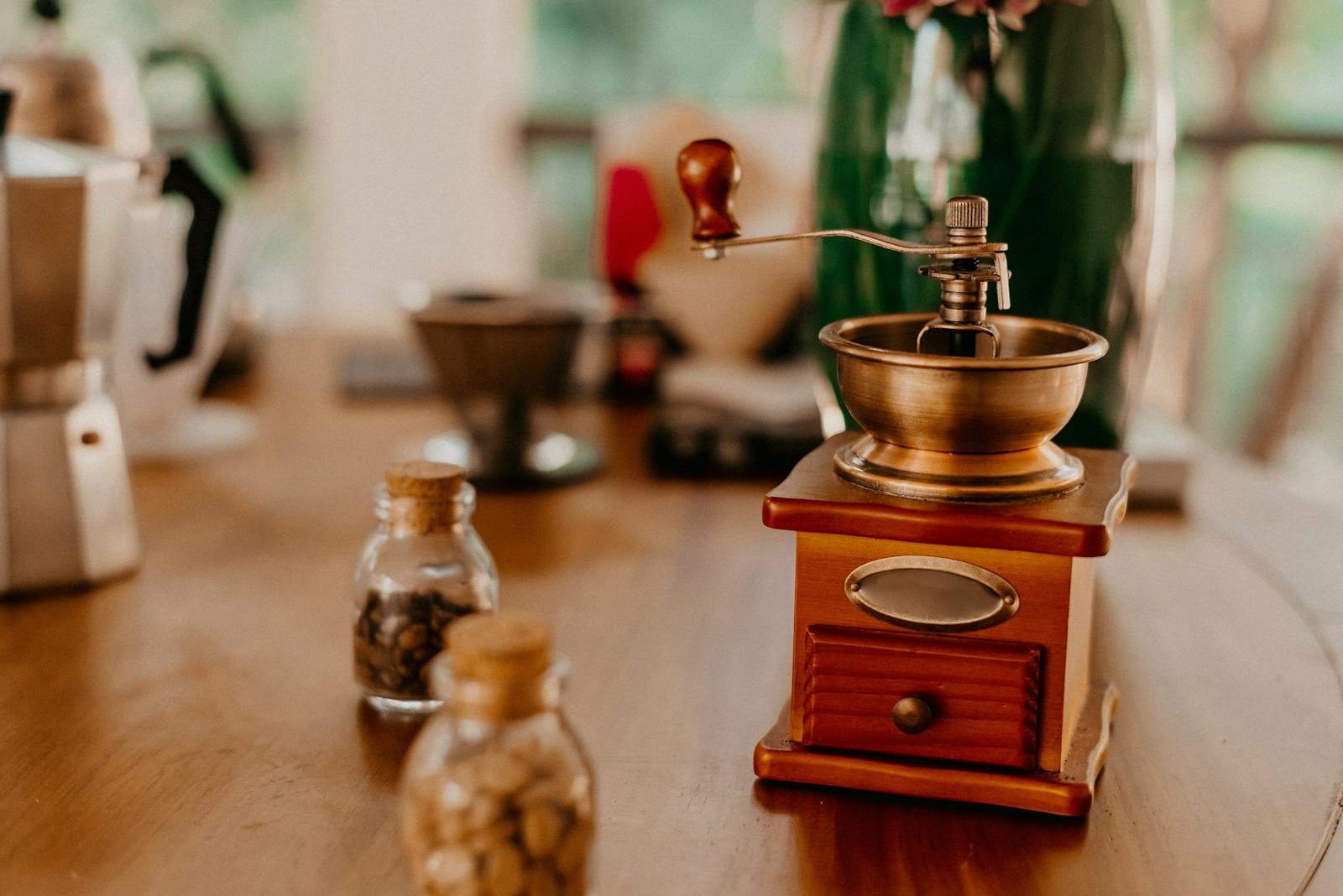
Antique coffee grinders are part tool, part time capsule.
Identify what you have, estimate value without hype, and clean it in a way that respects age (and resale).
That antique coffee grinder might be worth more if you don’t “restore it.” The fastest way to protect its value is to identify the type and maker marks, confirm what’s missing, and then clean it like a conservator—not like a weekend refinishing project. This guide walks you through quick identification, realistic dating, what collectors pay for, and a gentle restoration path so you can decide: display it, use it, or sell it—confidently.
Fast start: photograph it (all sides + any stamp), classify the style, confirm what’s missing, test the crank gently, then decide whether it’s for display, use, or sale.
Whether you call it a vintage coffee grinder, a retro coffee grinder, or a classic coffee grinder, the same basics apply: type, marks, completeness, and a gentle crank test.
Identify what you have in 5 minutes
Your goal isn’t a perfect year—it’s a confident category. Most older coffee grinders use burrs (metal surfaces that crush beans evenly) rather than blades. Most antique-style grinders also fall into a few families, and each family has different value expectations, replacement-part headaches, and display needs.
Start with what collectors do: identify the type, then look for maker marks (often on the base, crank arm, drawer front, or a metal tag). If you spot an Arcade mark, you may see similar models marketed as an Arcade Crystal coffee grinder in collector listings—so match the mark and the build details, not just the vibe. A quick “type-first” approach matches the research-first mindset you’ll see in collector research tips.
Type signals to spot fast
- Box mill: wooden cube + small drawer/cup; crank on top.
- Wall-mount: bolts or mounting plate; front drawer; often a glass hopper (often listed as a wall mounted antique coffee grinder).
- Store “wheel”: big cast-iron body, large wheel, countertop clamp or stand—this is the classic large antique coffee grinder category.
- Hand grinder: cylinder body (metal/wood), removable top, compact crank.
Quick red flags before you buy
- Repro finish: shiny “distressed” paint with uniform wear marks.
- Missing essentials: no drawer/bin, cracked hopper, or absent adjustment parts.
- Bad repairs: modern screws through visible faces, warped wood, glued handles.
- Misfit movement: crank turns but burrs wobble or rub metal-on-metal.
What to measure (it matters for both value and listings): overall height, base width/depth, drawer opening size, and the crank’s throw (how far the handle swings). Then note materials (cast iron vs stamped steel, hardwood vs softwood, porcelain/ceramic vs glass) and whether the grinder is complete: crank, knob, burr set, hopper/lid, drawer/bin, mounting hardware. A worn antique wooden coffee grinder reads differently to buyers than an antique cast iron coffee grinder, even if both turn smoothly.
When people ask about antique coffee grinder parts, they usually mean: burr set, adjustment mechanism, hopper/lid, drawer/bin, crank/knob, and any mounting hardware. Listing (or buying) gets easier the moment you can say which of those are present, original, and functional.
Date it without guesswork
Here’s how to date an antique coffee grinder without over-claiming: think in eras, not exact years, and build a case from materials, marks, and construction. You’ll also see the term antique coffee mill used interchangeably for these pieces. Museums and historical collections show how coffee mills evolved alongside home brewing and industrial manufacturing—use that context to keep your date range realistic, especially when parts have been swapped. A solid starting point is this coffee mill history (2024).
Treat every dating clue like a confidence level, not a verdict. One strong clue (a patent date on a tag) can beat five weak ones (like “it looks old”). You’ll also see listings labeled “1800’s antique coffee grinder”—treat that as a claim to verify unless you have a hard marker such as a patent date, consistent construction details, or provenance you trust.
| Clue you can verify | What it often suggests | Confidence | Notes (keep it honest) |
|---|---|---|---|
| Paper/foil maker label intact; crisp typography | Later production or careful storage | Medium | Labels can be replaced; look for matching wear on screws/edges. |
| Heavy cast iron with simple fasteners; robust drawer | Older build style or higher-end model | Medium | Cast iron was used for a long time—pair with mark/tag evidence. |
| Patent date or stamped model info on tag/base | Not earlier than the date | High | Patent date ≠ manufacture date, but it sets a solid floor. |
| Glass hopper + wall-mount form | Common in early-to-mid 20th century kitchens | Medium | Hoppers break and get replaced; check fit and age consistency. |
| Machine-cut screws, uniform hardware, modern coatings | Reproduction or later refurbishment | High | Modern hardware doesn’t always kill value—but disclose it. |
Know what drives value
Think of antique coffee grinder value as a bundle: type + maker + completeness + condition + originality. Even basic grinders swing widely depending on whether the burrs turn smoothly, the drawer is present, and the finish hasn’t been stripped to bare “new-looking” wood. A practical way to judge the bundle is this 2025 value checklist—then add your own discipline on top.
Reality check: prices commonly run from tens of dollars into the low hundreds when condition and completeness line up (LoveToKnow notes big swings by maker and originality). To avoid bad comps, compare like-with-like: small hand grinders vs wall-mounts vs big store models.
Printable condition + value worksheet
Fill this out once and you’ll have what you need for insurance, a listing, or a fair offer. Tip: print the page, or edit the fields right here.
| Grinder type Click to type… |
Maker / marks Click to type… |
| Materials (wood/iron/glass/etc.) Click to type… |
Estimated era range Click to type… |
| Completeness check (drawer, hopper, burrs, mount) Click to type… |
Function check (turns smoothly? burr rub?) Click to type… |
| Condition notes (rust, cracks, repairs) Click to type… |
Originality notes (finish, labels, hardware) Click to type… |
| Value drivers (what helps?) Click to type… |
Value drags (what hurts?) Click to type… |
| Next decision: Use / Display / Sell — why? Click to type… |
|
Collectors pay for “complete and believable.” That means the grinder shows honest age, but it hasn’t been rebuilt into something it never was. If you’re unsure whether a change helps or hurts, assume originality wins until proven otherwise.
Here’s the trap: “making it pretty” can reduce value. Thoughtful restoration advice favors selective cleaning and stabilization over full refinishing—especially when original finish, decals, or patina still read clearly. For a good gut-check, see refinishing vs patina and decide what you’re trying to preserve before you touch sandpaper.
Originality beats sparkle. Clean it, stabilize it, document it—then decide what (if anything) to repair.
Clean and restore without harming it
Start with low-risk steps: dry brush, gentle wipe-down, and careful vacuuming of loose grounds and grit. Then test the crank: smooth resistance is good; grinding, wobble, or binding is a warning. On an antique hand crank coffee grinder—basically any antique manual coffee grinder—the feel of the mechanism matters more than shine. If it feels wrong, stop and diagnose before you force it. For a detailed teardown reference, use hand-grinder restoration steps.
When you do open it up, think “stabilize and preserve.” Clean burr teeth so they bite evenly, keep every original screw and washer organized, and reassemble slowly. If you replace a part, save the original in a labeled bag so your grinder stays “documented,” not “mysteriously modified.”
Safety note (use vs display)
If you plan to grind beans for drinking coffee, be cautious with unknown finishes, coatings, corrosion, or any part that contacts food. When in doubt, choose display-only or use a modern grinder and keep the antique for décor.

Do (value-safe)
- Document: photograph every side and every part before disassembly.
- Clean gently: minimal water on wood; dry immediately.
- Stabilize: stop active rust; lightly oil moving metal after cleaning.
- Test slowly: turn by hand before adding beans.
Avoid (common value killers)
- Strip/sand: removing finish can erase labels and authentic wear.
- Paint “antique”: new paint often reads as reproduction.
- Force the crank: you can chip burrs or bend shafts.
- Swap parts casually: mismatched knobs, drawers, or hoppers hurt believability.
If yours is already “over-restored,” treat it as décor—and disclose changes plainly if you sell it.
Buy, sell, and display like a collector
The best deals happen when you buy with a checklist, not a vibe. If you’re browsing antique coffee grinders for sale (or writing an antique coffee grinder for sale listing), marketplaces—including “coffee grinder ebay” searches—reward clear measurements and honest function notes. If you’re shopping, compare listings the way Antique Trader encourages: type first, then marks, then completeness, then condition.
Buying (bring these questions)
- Completeness: what’s missing, and can you live with it?
- Function: does it turn smoothly, and do burrs meet evenly?
- Evidence: are marks, tags, and wear consistent across the piece?
- Purpose: are you collecting, decorating, or hoping to use it?
Selling + shipping (reduce surprises)
- Measurements: height, base size, drawer opening, mount spacing.
- Photos: underside, inside, burrs, drawer removed, cracks/repairs.
- Packing: remove the drawer and wrap separately; immobilize the crank; pad the hopper.
- Disclosure: say “turns,” “binds,” or “unknown” if you didn’t fully test.
| Common listing claim | Reality check (what to ask/verify) |
|---|---|
| “Rare!” | Ask for maker marks, model tag, and dimensions; rarity without proof is just excitement. |
| “All original” | Look for mismatched screws, fresh stain/paint smell, or hardware that’s too new for the wear. |
| “Works” | Clarify: turns smoothly? burrs aligned? any wobble or metal scraping? |
| “Restored” | Ask what was changed and whether original parts are included. |
For display, treat it like a small artifact: keep it dry, avoid direct sun (labels fade), and don’t store it with beans inside (oils attract dust and odors). Don’t mix categories when you price-shop: antique corn grinder value doesn’t translate cleanly to coffee—verify you’re comparing coffee burr mills to coffee burr mills. Your worksheet plus photos doubles as a simple “provenance packet.”